Curious beginner
You want to test a simple nameplate or storage hook without installing desktop software.
A small brief keeps the first session focused and makes the free tinkercad route easy to judge.
free tinkercadAccess guide
Tinkercad for free is easiest to approach as a browser-first project path: choose a small goal, test the workspace, and keep only the output you need.
Before you begin
A smooth first session needs only a modest brief, a current browser, and a clear idea of whether you are testing 3D design, circuits, or code.
Choose a small goal
The easiest way to evaluate Tinkercad is to run one contained project from idea to a saved or exported result.
You want to test a simple nameplate or storage hook without installing desktop software.
A small brief keeps the first session focused and makes the free tinkercad route easy to judge.
free tinkercadYou need to see whether the workspace suits a class or personal project before committing to a longer workflow.
A short trial reveals which access steps your browser presents before you build anything substantial.
tinkercad without signupYou move between school, home, or a library computer and need a repeatable browser entry point.
The project stays centered on an online Tinkercad workspace rather than a local installation.
tinkercad onlineYou are comparing a simple solid-building workflow with more advanced design software.
A small test shows whether Tinkercad’s lighter interface matches your current goal.
tinkercad softwareThree simple moves
Use this short run-through to avoid wandering through every feature before you know what the free route needs to deliver.
Choose one object or one circuit behavior with a visible result. A narrow task makes the Tinkercad interface easier to learn and evaluate.
Start in 3D design for shapes, Circuits for electronics, or the Arduino path when code is part of the experiment.
Save, share, or export only after checking the finished object, wiring, or code behavior against your original brief.
Set expectations
A small, finished test is more useful than opening every tool at once.
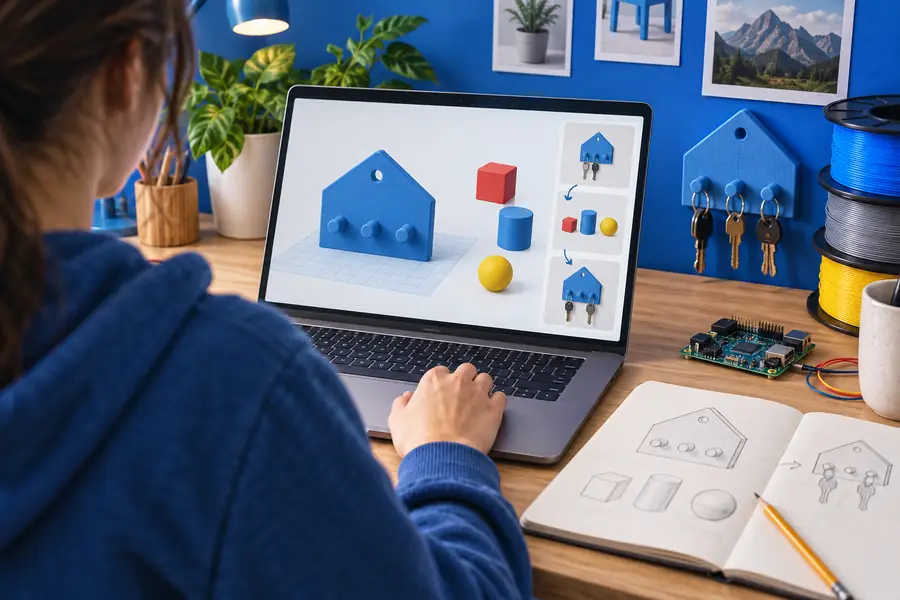

What the route covers
The free path is broad enough for introductory making, with separate areas for shape-based design and electronics experiments.
Know the edges
Free access can be useful without covering every situation. These are the common boundaries to check before making the project larger.
A browser-centered Tinkercad session is not the same as having a full local desktop application available without connectivity.
WorkaroundPlan a connected session and save important work as you go.
The approachable modeling workflow may not replace the constraints, assemblies, or engineering controls needed for complex mechanical work.
WorkaroundKeep the project conceptual or move advanced work to a tool built for that level of control.
A completed digital model or circuit simulation does not produce a physical object or electronic build by itself.
WorkaroundExport the required file or use the simulation as a build reference.
A free route may look different for personal, school, or shared-device use, especially when a workspace adds its own access steps.
WorkaroundTest the exact browser and workspace context before planning a group workflow.
Common questions
These answers focus on what people usually mean when they search for free Tinkercad software or a no-cost starting route.
The core Tinkercad experience is commonly presented as free to start. The exact entry path can still depend on the workspace or access context, so check the screen shown for your situation.
The free path is suited to introductory 3D work and browser-based electronics exploration. It is not a blanket promise that every school, team, or advanced workflow is included.
Yes, a small 3D project is a sensible way to evaluate the workspace. Start with a few basic shapes, confirm the result, and avoid adding complexity until the first object works.
Tinkercad has separate circuits and Arduino-oriented workflows for experimenting with electronics and code. Treat them as learning and simulation paths, then verify any physical build separately.
No. It is designed to make early 3D design and electronics exploration approachable, while professional CAD suites usually provide deeper engineering controls and more specialized workflows.